Your CRM Knows Your Pipeline. Your Finance System Knows Your Margins. Nothing Knows Both.
The Attercop Platform connects the systems a professional services firm runs on, makes them queryable in natural language, and deploys governed AI agents that earn autonomy through proven performance.
The cost of fragmented operations
Partners preparing for client meetings by checking six systems. Project managers reconciling timesheets against project plans by hand. Business developers hunting through folders for proposal precedents. The knowledge that walks out the door when a senior consultant or partner moves on.
Research suggests that knowledge workers spend roughly 30% of their working day searching for information they need to do their jobs. The average professional switches between applications over 1,200 times per day. For a consultancy or professional services firm, this translates directly into margin pressure: senior people spending their most expensive hours on context assembly rather than client work.
The deeper cost is institutional knowledge loss. 42% of institutional knowledge resides solely with individual employees. When a partner who managed a client relationship for three years moves on, the successor inherits the accounts but not the context: why certain approaches were chosen, what the client's unspoken preferences are, which proposals succeeded and which failed, and what was learned from each.
30%
of the working day spent searching for information
1,200+
application switches per professional per day
42%
of institutional knowledge residing solely with individuals
Most firms know this is a problem. The typical response is to try harder with the tools they have: better CRM discipline, more structured filing, regular knowledge-sharing sessions. These help at the margins but do not solve the structural issue. The data is fragmented because the systems are fragmented. No amount of process can fix an architecture problem.
Three layers of value. Each one independently useful.
One view of your firm
Your CRM, resource planning, finance, HR, and document systems connected into a single canonical data layer. Records resolved across systems. Unified dashboards showing pipeline, engagements, utilisation, and margins together. Cross-system reporting without manual reconciliation. Dashboards that update from live data, delivered through a managed Metabase layer that your team can use without technical skills.
Ask anything about your business
“What is our pipeline looking like this quarter?” answered in seconds, drawing from CRM, project data, and financial records simultaneously. “Show me everything related to this client” returns deals, engagements, team allocations, invoices, documents, and meeting notes in one view. “Who is available for a new engagement starting next month?” answered from resource planning and time tracking data, reconciled. Available in the Platform's built-in chat interface or via MCP in Claude Desktop, CoPilot, and other AI tools your team already uses.
Operational intelligence that acts
Meeting briefings assembled before every client call. Timesheet gaps identified with draft entries prepared for review. Stale pipeline deals flagged with suggested follow-up actions. KPIs tracked and surfaced automatically. Each agent operating within governance bounds, earning autonomy incrementally. Every suggestion requires human approval until trust is established. Every action logged.
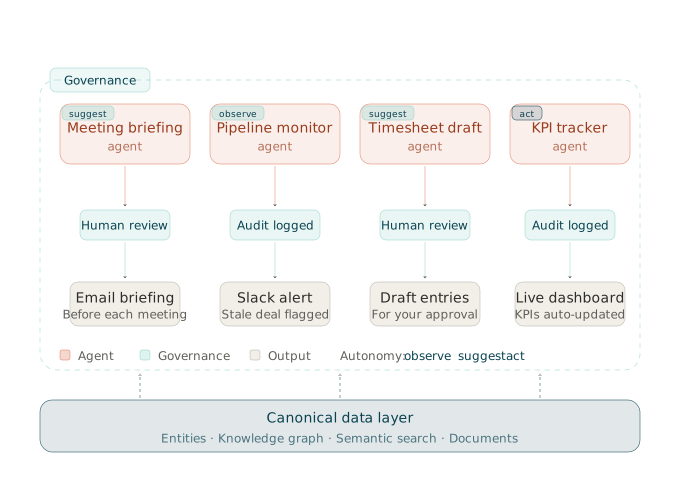
The longer you run, the smarter your firm becomes
This is the most differentiated value the Platform provides for professional services firms, and it is worth dwelling on.
Most discussions about AI agents focus on automation: doing things faster. The deeper value is institutional memory: getting smarter over time.
The Platform captures decision context as a natural by-product of daily operations. Every significant decision is recorded with its reasoning, its outcome, and its context. Precedents from past engagements inform future proposals. The knowledge from a client relationship that spanned five years does not disappear when the responsible partner moves on. New joiners inherit the firm's accumulated judgement, not just a handover document written in their predecessor's last week.
Over time, the firm accumulates a body of operational wisdom that is independent of any individual. The fifth year of operation is measurably smarter than the first, in ways that a competitor starting from scratch cannot easily replicate. This is the compounding effect that separates a reporting system with AI bolted on from a genuine operational intelligence platform.
Built on ours. Ready for yours.
Attercop is a specialist consultancy. We run on the same operational systems you do: CRM for pipeline, resource planning for delivery, finance for invoicing, documents for knowledge.
We built the Platform to solve our own data fragmentation problem. We use it every day. Before every client meeting, a briefing is assembled automatically. When a new team member joins an engagement, they inherit the full context. We stopped manually reconciling data across systems months ago.
The Platform is delivered as a managed service. We handle the data pipelines, the identity resolution, the agent governance, and the platform operations. Your team interacts through natural language and familiar interfaces.
The whitepaper
We wrote “An Agentic Framework for Professional Services Firms” for managing partners and COOs who want to understand the approach before picking up the phone.
It covers the data fragmentation problem, the three-layer architecture, the progressive trust model, the deployment sequence, and the institutional memory argument. No sales pitch. Just the thinking behind the Platform.
Get Your Copy
Enter your details and we will send the whitepaper to your inbox.
Continue exploring the Platform
Start with a conversation.
Every firm's data landscape is different. The right starting point depends on your systems, your team, and what operational questions you most need answered.