The Architecture Behind Operational Intelligence
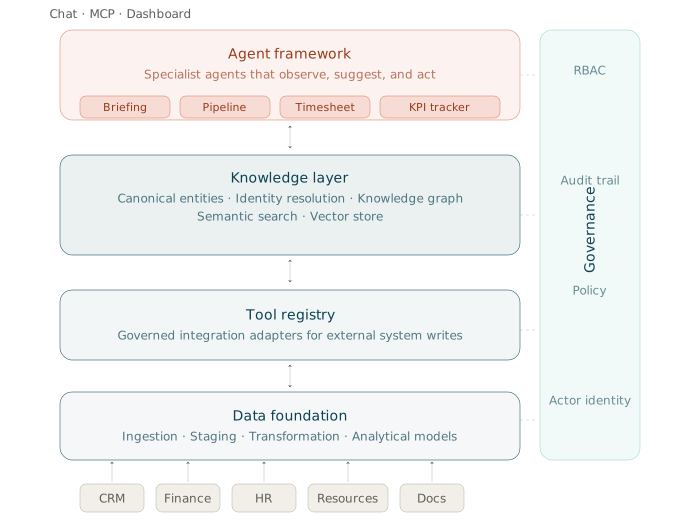
A four-layer platform that separates deterministic infrastructure from probabilistic reasoning. Every consumer, whether human or agent, goes through the same governed service layer.
Four layers. One governing principle.
The Platform is built on a simple architectural rule: the infrastructure layers are entirely deterministic. Input A always produces Output B. All non-determinism, the LLM reasoning, agent planning, and natural language interpretation, lives in the agent framework and the chat interface. These consumers call the infrastructure as a tool. This separation is what makes governance tractable.
Data foundation
Raw ingestion from source systems via automated sync pipelines. Staging, transformation, and analytical models. This is the pipeline layer that turns raw system data into clean, structured, queryable information. Connectors for CRM (Salesforce, Pipedrive, HubSpot), resource planning (Forecast, Kantata), finance (Xero, Sage, QuickBooks), HR (BreatheHR, HiBob), document management (Google Drive, SharePoint, OneDrive), calendar (Google Calendar, Outlook), and communication (Slack, Teams). If a system has an API, we can connect it.
Knowledge layer
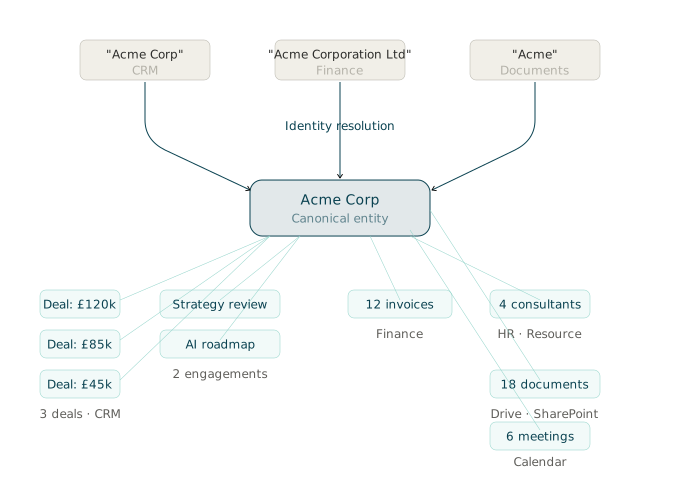
Canonical entities and identity resolution. The same client, engagement, or team member is recognised regardless of which source system the record originated in. “Acme Corp” in CRM, “Acme Corporation Ltd” in finance, and “Acme” in a document title all resolve to a single canonical entity.
On top of the resolved entities sits a property graph of relationships and a vector store for semantic search. The graph connects clients to deals, deals to engagements, engagements to team members, team members to documents, documents to meetings. The vector store enables natural language queries across the full document corpus.
This is where “five systems” becomes “one truth.” A question like “show me everything related to this client” returns deals, engagements, team allocations, invoices, documents, and meeting notes in a single traversal of the graph.
Governance
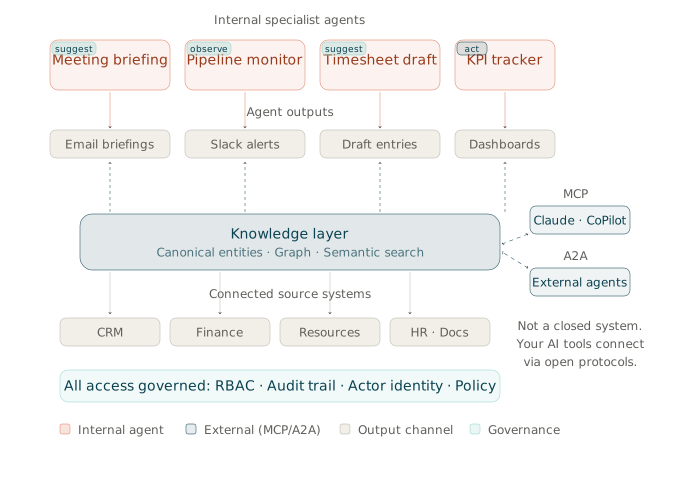
Every request, whether from a human user, the chat interface, or an autonomous agent, passes through the governance layer before reaching data or services.
Fine-grained role-based access control ensures every user and every agent sees only what their role permits. A project manager sees their project data. A partner sees their practice data. An agent inherits the permissions of its configured role. Data segregation operates at the entity level, not the system level.
Full audit trails log every action with actor identity (who or what initiated it), timestamp, and context. Agent performance dashboards track accuracy, latency, and cost. Decision traces capture not just what happened but why: the reasoning chain, the data consulted, the confidence level, the governance policy that applied.
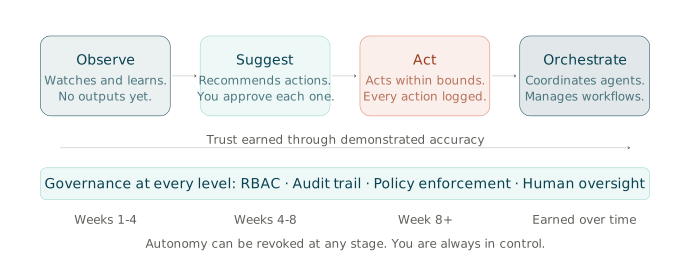
Progressive autonomy operates at four levels: observe (the agent watches and learns), suggest (the agent recommends actions for human review), act with audit (the agent acts within bounds, every action logged), and orchestrate (the agent coordinates other agents). Agents start at observe and earn expanded permissions through demonstrated accuracy. Autonomy can be revoked at any stage.
The Tool Registry sits within this layer: governed integration adapters for outbound writes to external systems. When an agent needs to create a calendar entry or update a CRM record, it goes through a registered, governed tool. No direct system access.
Agent framework
The reasoning layer. Specialist agents that observe, suggest, and act on the data and knowledge layers below, within the governance bounds defined in Layer 3. The agent framework includes orchestration for multi-agent workflows, memory for short-term task context and long-term knowledge access, and the progressive trust model that governs how agents earn autonomy.
Agents are not general-purpose chatbots. Each agent is a specialist: one assembles meeting briefings, another monitors pipeline health, another drafts timesheet entries. They inherit the permissions and context of their configured role, and they produce structured outputs delivered through configured channels (email, Slack, dashboard, or API).
Why identity resolution matters for AI quality
Most AI tools connect directly to your source systems via APIs and ask an LLM to synthesise the results at query time. This works for simple, single-system questions. It degrades on anything that requires understanding relationships across systems, because the LLM has no persistent model of how your data connects.
The Platform takes a different approach. It ingests data from your source systems, resolves entity identities, and builds a traversable graph of relationships between entities. When you or an agent asks a question, the answer is drawn from this unified, pre-resolved model, not from ad hoc API calls.
The practical difference: a direct-API approach might tell you what your CRM says about a client. The canonical approach tells you everything your firm knows about that client, across every system, in a single query.
This is the architectural bet that makes the Platform's AI results materially better than connecting an LLM directly to your tools. The quality of AI output is bounded by the quality and connectedness of the data it can access. A well-resolved canonical layer with a traversable graph produces fundamentally different results from a set of disconnected API calls.
Not a closed system
The Platform participates in the emerging agent ecosystem through industry-standard protocols.
MCP (Model Context Protocol) allows your existing AI tools, whether Claude, CoPilot, or your own agent frameworks, to access the Platform's canonical data layer without switching interfaces. Your AI assistant gains the context of your actual business operations.
A2A (Agent-to-Agent Protocol) enables specialist agents to be discovered and coordinated by external orchestrators. A firm using Microsoft CoPilot Studio as its primary interface can delegate tasks to the Platform's specialist agents, such as meeting briefing, entity resolution, and knowledge retrieval, via standard protocols.
Both MCP and A2A are governed by the Linux Foundation's Agentic AI Foundation, with backing from Anthropic, OpenAI, Google, Microsoft, and AWS. The Platform is infrastructure that your existing AI investments can build on.
If you are evaluating platforms for technical fit, we are happy to go deeper.
We can walk through the architecture against your specific systems, data landscape, and governance requirements.
Request a Technical Deep Dive